COURSE TITLE: Food Engineering 2
COURSE OVERVIEW:
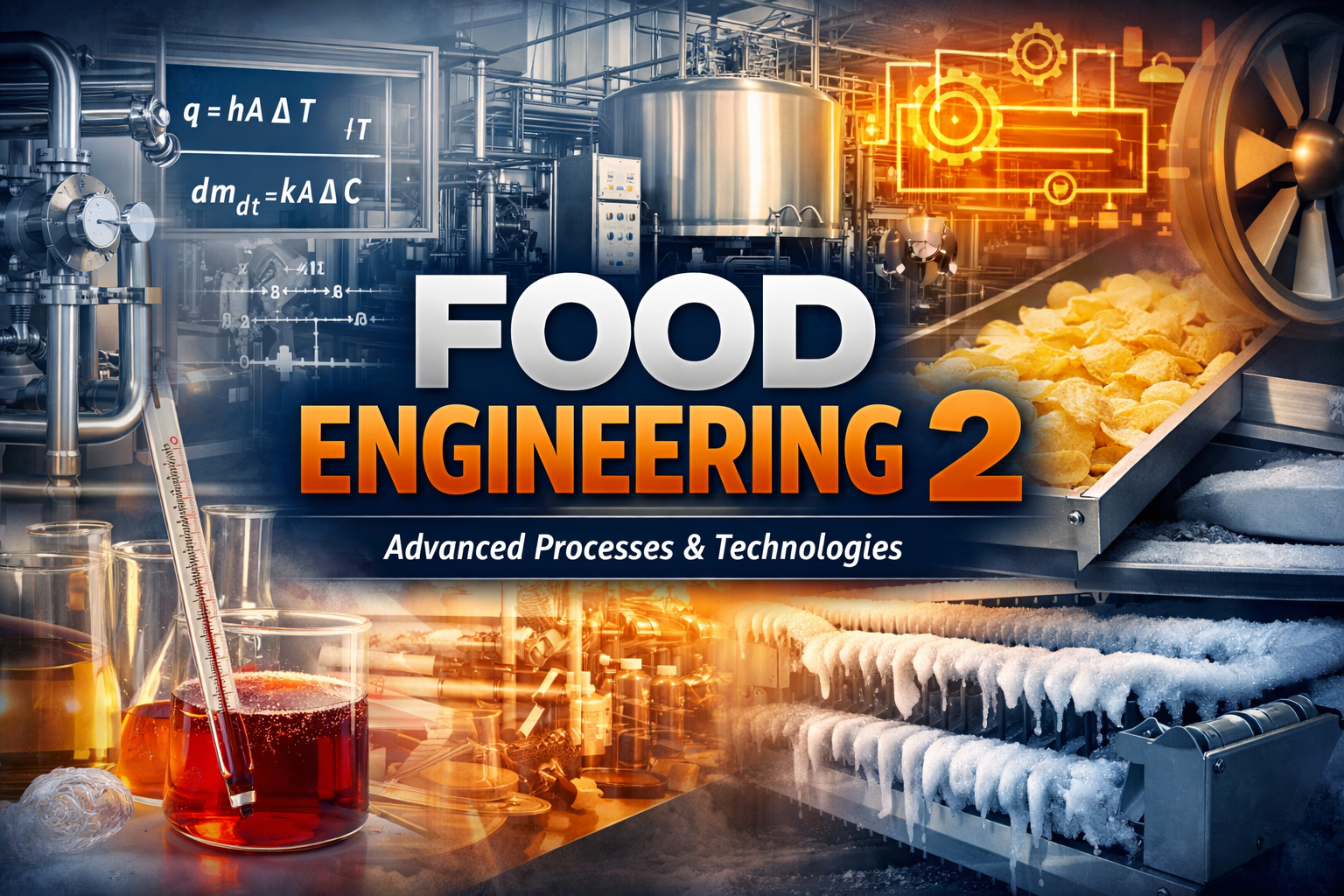
Food Engineering 2 builds on foundational concepts to explore advanced principles of food processing, heat and mass transfer in foods, fluid flow, and equipment design. The course emphasizes practical application in food industries, enabling students to design, optimize, and troubleshoot processes that ensure efficiency, safety, and product quality.
LEARNING OUTCOMES:
By the end of this course, the trainee should be able to:
1.Apply advanced principles of heat and mass transfer in food processing operations.
2.Analyze fluid flow and mixing processes in various food systems.
3.Evaluate and design food processing equipment for industrial applications.
4.Solve real-world problems related to thermal processing, refrigeration, and drying of foods.
5.Integrate engineering concepts to optimize food safety, quality, and energy efficiency.
CORE UNITS:
1.HEAT TRANSFER IN FOOD SYSTEMS – conduction, convection, and radiation; heat exchangers.
2.MASS TRANSFER OPERATIONS – drying, evaporation, and osmotic processes.
3.FLUID FLOW AND MIXING – laminar and turbulent flow, pumps, mixers.
4.FOOD PROCESS EQUIPMENT DESIGN – design principles, selection, and operation.
5.THERMAL PROCESSING & PRESERVATION ENGINEERING – pasteurization, sterilization, refrigeration.
6.ENERGY EFFICIENCY & SUSTAINABILITY IN FOOD PROCESSING – reducing waste and optimizing processes.
SAMPLE INTERACTIVE ACTIVITIES:
a)LABORATORY SIMULATIONS: Modeling heat and mass transfer in drying or heating processes.
b)FIELD VISITS: Industrial observation of food processing plants.
c)PROBLEM-SOLVING SESSIONS: Designing a small-scale food processing unit.
d)GROUP PROJECTS: Case studies on improving efficiency in food production lines.
e)QUIZZES AND POLLS: Quick assessments on engineering calculations and principles.
- Teacher: Admin User